The video linked below is located on YouTube.
Tai Chi And The Single Cylinder View Of The Human Body Part 02
A web page duplicate of the video is also provided for those who prefer to read, and for more leisurely study.
—————————–
This video is part 2 of The Single Cylinder View of the Human Body and it’s relationship to the practice of Tai Chi.
The first video of this series defined the Single Cylinder View of the human body as a vertical cylinder located on the human body as shown in this picture. The first video stated that the Single Cylinder View of the Human Body was based on the natural cylinder formed by the rib cage and the pelvis.
The first video also stated that one of the goals of Tai Chi was to strengthen the muscles, tendons, etc that hold the rib cage and the pelvis in a proper cylindrical shape. The first video ended by stating that, according to the laws of physics, the closer to a proper cylindrical shape and the closer to proper alignment the cylinder in the human body becomes, the more power a Tai Chi practitioner would be able to generate and deliver.
This second video will provide evidence from the Tai Chi form that supports the Single Cylinder View of the Human Body, and the claim that one of the goals of Tai Chi is to create and strengthen the cylinder formed by the rib cage and pelvis of the human body.
The next section of the video will show a man performing the first section of the Tai Chi form. While watching the performance, look for any evidence in the Tai Chi form that might support the Single Cylinder View of the Human Body.
It may be overwhelming to view the Tai Chi form and pick out any one part of it as being related to a single cylinder. To make the job easier, it would be helpful to be clear about what type of movement is being looked for.
Cylinders are known for rotating about their long axis. A cylinder looks the same from any angle so it can be hard to see the rotation of a cylinder. The cylinder in this animation is rotating right now, but there is no way to tell because a cylinder looks the same from any angle.
To remedy that problem, a mark is placed on the cylinder. If the cylinder rotates now, the movement of the reference mark verifies that the cylinder is rotating.
The example cylinder is then moved to stand vertically so it matches the vertical orientation of the cylinder of the Single Cylinder View of the Human Body.
This animation shows how the vertical cylinder looks when it rotates.
It was previously stated that the vertical cylinder in the human body is based on the rib cage and pelvis. That implies the rib cage and pelvis should rotate like the vertical cylinder in the previous animation rotated.
Now that the exact type of movement that is being looked for has been demonstrated, a rotation of the body around the vertical center axis of the body, please watch the man perform Tai Chi again, while looking for any evidence of a movement in the form that looks like a vertical cylinder rotating about it’s center axis
The Tai Chi form does contain evidence of a movement of the body that is similar to the movement of a vertical cylinder rotating about it’s center axis. Were you able to find it on your own?
If not, the next part of the video will highlight how the human body rotates about it’s vertical center axis during the performance of the Tai Chi form, in the same way a vertical cylinder rotates about it’s center axis.
In this picture, a transparent cylinder has been superimposed on the body of the man in the location defined by the Single Cylinder View of the Human Body. The reference mark on the cylinder is aligned on the eyes of the man.
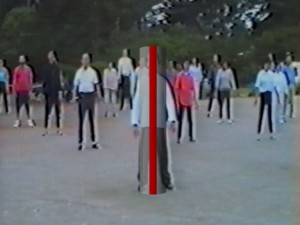
The next part of the video will show the man performing the Tai Chi form again. This time though, the transparent cylinder superimposed on his body will follow the movements of the man. The cylinder will be moved so that the reference mark on the cylinder is always aligned on the eyes of the man.
The video clip showed that the reference mark on the cylinder constantly rotated to the right and left during the Tai Chi form. The reference mark could only rotate if the man’s eyes were rotating, because the reference mark had to stay aligned on the man’s eyes.
The head stays aligned with the torso when performing Tai Chi. Therefore, the eyes could only rotate if the entire torso rotated also.
This video has proved that the torso of the human body rotates like a cylinder during the performance of the Tai Chi form. That proof adds support to the validity of the Single Cylinder View of the Human Body, and to the claim that the purpose of some of some of the movements of Tai Chi is to create and strengthen the cylinder formed by the rib cage and pelvis of the human body.