This video will benefit any Kung Fu Man practicing any style of kung fu.
If an individual decides to only view a few Happeh Theory videos, this video should be one of those chosen. It is that insightful.
[youtube=http://www.youtube.com/watch?v=37g4drBXRxc]
A web page duplicate of the video is also provided for those who prefer to read, and for more leisurely study.
—————————————————————
This video demonstrates one reason why circles are important to the practice of Tai Chi.
The practice of Tai Chi is commonly associated with what is called “circular power”. What is circular power? The complete answer to that question is very complicated. This video contains a visual demonstration that will provide insight into the concept of circular power.
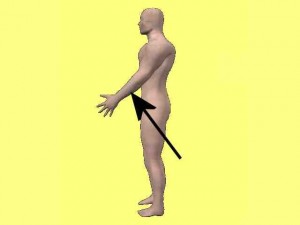
Here is a picture of a of a human being with their arm raised up in the air and a human being with their arm straight down at their side.
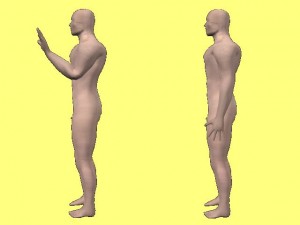
If a person was asked to describe how the straight arm was raised up into the air, they might describe it as the result of straight line forces applied to the arm. The next picture shows an arrow pointing at the back of the upper arm to represent the straight line force.
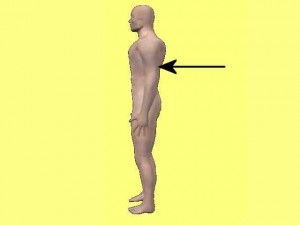
Then a picture showing the left arm after the straight line force has moved it, and a direction change of the force arrow to follow the new orientation of the arm.
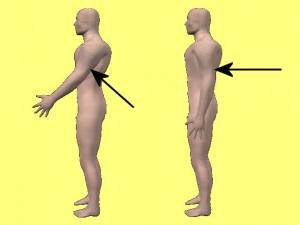
Once the upper arm is in position,
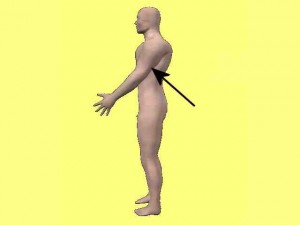
a straight line force would be applied to the lower arm,
to raise it into the desired position as shown in this picture.
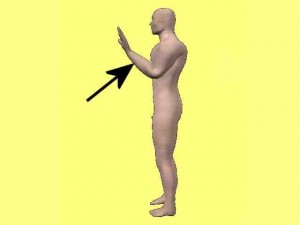
The next picture shows the lower arm in it’s final resting position.
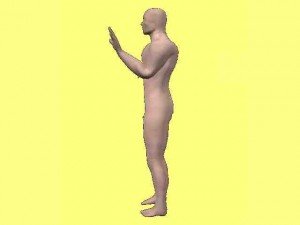
The application of straight line forces to the arm as shown in the demonstration is one way the arm could be moved from the striaght at the side position into the raised position.
When discussing Tai Chi, it is often recommended that the movements should be performed in a circular way. What does “to move in a circular way” mean?
In this situation, “moving in a circular way” would mean that the the arm can be moved from the straight at the side position into the raised position by a circular movement.
How can the arm be moved from the straight at the side position to the arm raised position by a circular movement?
Here is a picture of a real life person.
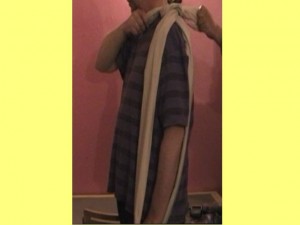
The arm of the person is hanging straight down their side like the arm of the computer model.
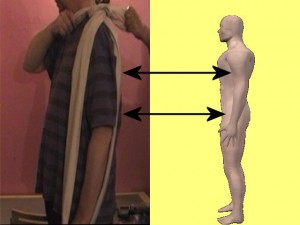
There is a circle of cloth looped around the arm of the person from the hand up to the shoulder.
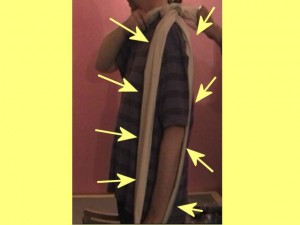
The cloth circle has a slipknot in one end of it.
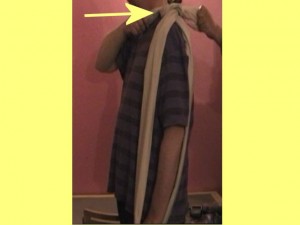
The other end of the cloth is threaded through the knot and can move freely back and forth.
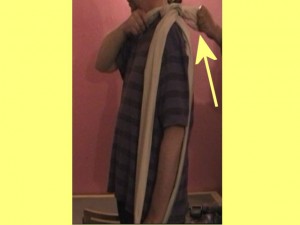
The demonstration begins when the free end of the circular cloth is pulled towards the right. As the free end of the cloth circle is pulled, the circle becomes smaller in diameter. As the cloth circle becomes smaller in diameter, the lower and upper arm trapped within the circle are forced to move.
The arm of the real life person is now in a position similar to the one held by the computer model.
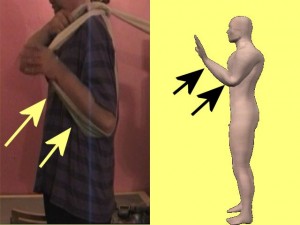
Instead of straight line forces moving the arm to the raised position as in the case of the computer model, the arm of the real life person was raised up by the circular force exerted by the cloth circle.
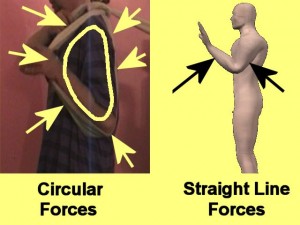
The same process works for the legs.
In this picture the cloth loop is wrapped around the foot and held up towards the hip.
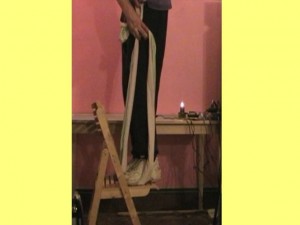
When the free end of the cloth loop is pulled, the leg is raised upwards in the same way that the arm was raised upwards.
This video has demonstrated that the arms and legs of a human being can be moved by a circular force.
The muscles of the arms and the legs are straight.
There are no circular muscles that connect the shoulders to the hands or the hips to the feet. How is the circular force exerted by the cloth loop in the video example created by the human body?
The answer to that question will take you years to discover.
Or maybe I will make a video about it.
😉