More unorthodox training methods for Goku and Crillen. In the first example, Master Roshi takes them to a farmer’s fields where he tells them they have to plow a farmer’s field with their hands.
Of course this is a bit much to do in real life. The underlying concept is valid though. If you were to go in your backyard and do similar exercises in a garden, your body and specifically your hands will toughen up after a few months.
It is interesting to note that Goku and Crillen use different methods to till the fields. Goku digs with his hands pulling him forward.
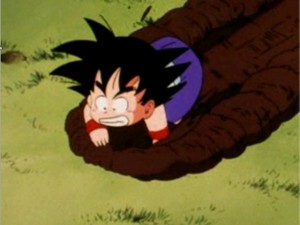
Crillen backs into the field pulling his hands after him.
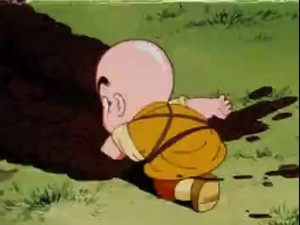
This is not just some random difference. Each method would develop the body in a different way.
The next training is mundane. Master Roshi takes the boys to a construction site where they work. They push wheelbarrows, pull rollers, carry dirt and dig with tools. This is another example of real world training found in the cartoon. A person could go get a job as a construction worker and become as strong or stronger than they would if they were to work a corporate job and go to the gym.
The boys then take a break for book learning. In this cartoon created by japanese people, they have Master Roshi give the boys a speech about the importance of book learning. This is more than just an average cartoon’s government mandated message in my opinion. This is a cartoon about martial arts where you would expect an emphasis on the physical training or action and excitement. Master Roshi explains to the boys they need brain power so they know how to use their body. This same admonisment applies to all people, adults as well as children.
Master Roshi then leashes the boys to a tree with a length of rope.
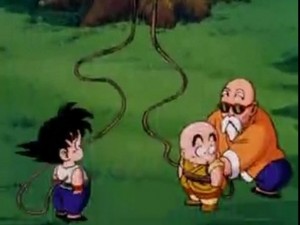
After that he strikes a hornets nest hanging in the tree and runs for cover. The point of this training is that the boys are supposed to dodge the hornets so they do not get stung.
Because being tied to a tree limits their movements, Crillen and Goku are forced to learn to move in confined spaces if they want to avoid being stung. Master Roshi explains this before he hits the hornets nest. A person could do the same training with a less drastic method of motivation.
During their work at the construction site, Crillen has a daydream. It turns out that before he met Master Roshi, Crillen was at another school. The students were physically and verbally abusive to Crillen. As Crillen remembers this, he becomes angry and begins to work harder and harder. This sequence reveals a few ideas that apply to real life.
The bully sequence is very realistic. The dialog is accurate for a children’s cartoon. Bullies are frequently motivated for the reasons stated and they frequently act and talk in the way the cartoon depicts. Another important concept is of emotion being a strong and common motivator in kung fu. In real life, many people take kung fu because they have been bullied or they feel fear for some reason. This emotion can be harnessed and channelled into practicing just as Crillen does in the cartoon.
This clip is interesting to me because of the depiction of “You get what you put out”.
Goku is always nice, always polite. He is never angry or abusive or disrepectful. The only time he acts bad is if he is dealing with bad guys. In this clip, Goku becomes impatient with Master Roshi. Goku wants to learn kung fu now and Master Roshi does not think he is ready.
Goku has a mean or angry look on his face when he challenges Master Roshi. This is an important event in a kung fu situation. Since kung fu is about physical violence and domination, it is common for the student to challenge the teacher. For the teaching relationship to continue, the teacher must chastise the student and put him in his place.
This is exactly what happens. Master Roshi immediately scolds Goku about his not being ready. He also makes physically threatening gestures with his arms and his entire body. I think this example is similar to the type of exchange you would encounter in many real life situations with strong young men learning from older men. For me, the interplay of the speech is revealing. The voice actors are very good. Master Roshi’s voice counters Goku’s voice in a way that is hard to describe. You might listen to it to see if you notice anything special about their exchange.
The final lesson of the day is one that can be used by anyone in real life. Master Roshi tells the boys they will do the same chores every day. Only they will wear 50 pound turtle shells on their backs when they do.
This is a method of training that will work and will produce real world results. It is not an imaginary invention for the cartoon, although most people will likely wear something other than a turtle shell to provide the additional weight.
I was out walking in the park one day and I saw someone who was doing this. The person had a backpack on. As he walked by he stopped within my view and I saw him bend over and pick up a rock. He looked at it and brushed at it like it was an interesting rock. He then opened his backpack and dumped it in there with some other rocks that were already there.
It is an easy exercise to do. Every time you go out for a walk just throw a backpack on and throw some rocks in it. Take the dog for a walk, take the backpack. Go to the store for groceries, take the backpack. Go out just because it is a nice day, take the backpack.