Probably the easiest to understand and the most useful of the theoretical models of the human body created for Happeh Theory, is The Single Cylinder View of the Human Body. According to The Single Cylinder View of the Human Body, a human body can be treated as a large cylinder located as shown in the picture below.
According to The Single Cylinder View of the Human body, some of the behavior of the human body can be modeled by treating the complex human body shown here in a front view
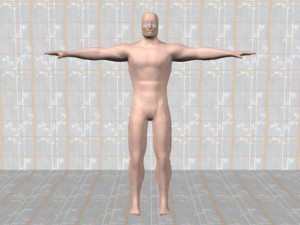
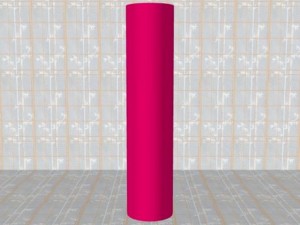
as if it were a single cylinder like the one shown in this front view picture.
Here is a profile view of the human body.
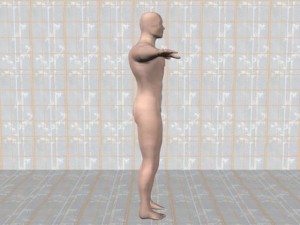
And the single cylinder in the profile view.
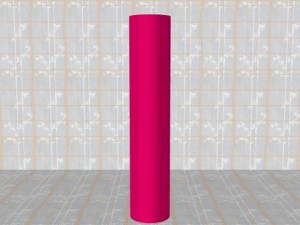
The single cylinder looks exactly the same in the front and the profile views because a cylinder is symmetrical. A cylinder is the same on both halves side to side and both halves front to back, so it looks the same no matter what direction the picture is taken.
This next picture is of a human being from an angled overhead view. This viewing angle reveals the three dimensional nature of the human body.
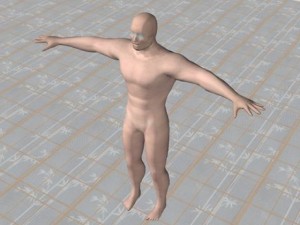
And the single cylinder from the angled overhead view proving that the single cylinder is a three dimensional object.
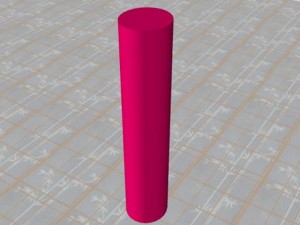
Now that the human body and a single cylinder have been provided for visual inspection to determine their characteristics, the Single Cylinder View of the Human Body can now be demonstrated.
————————————-
The Single Cylinder View of the Human Body says that in some cases the human body behaves like a large single cylinder which is located on the human body as shown in this front view picture.
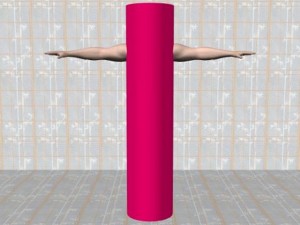
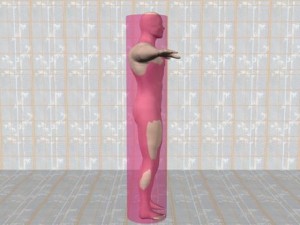
This picture shows that the single cylinder encases most of the body, but that is all. For a better idea of the relationship between the single cylinder and the human body, in this picture the cylinder has been made partially transparent so the human body can be seen within.
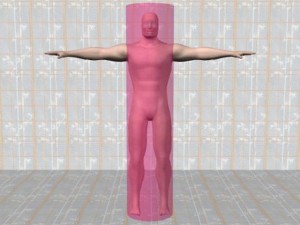
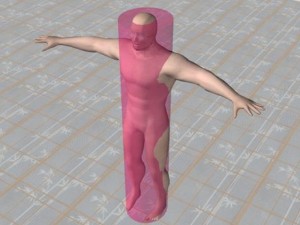
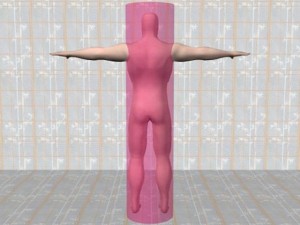
With the cylinder transparent, it is now possible to see that the hips and the shoulders look to be the only part of the body actually touching the single cylinder. The legs, the head, the rest of the torso are not actually touching the cylinder.
Please retain that observation for later consideration.
Here is the profile view of both the human being and the semi transparent single cylinder.
And the angled overhead view of the human being / semi transparent cylinder combination.
The view from the rear of the human being and semi transparent cylinder.
And the view from directly overhead of the human being and semi transparent cylinder.
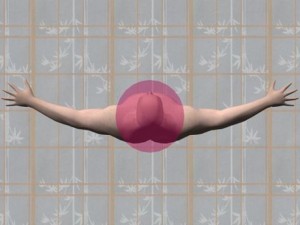
The pictures above should allow the reader to view any aspect of the releationship between the single cylinder and the human body.
———————
The single cylinder shown in the pictures above does not have to be that exact diameter where only the shoulders and hips touch the cylinder.
An infinite number of single cylinders of different diameters could be superimposed on the body for demonstration purposes as long as the vertical center of the cylinders is located on the vertical center of the human body.
Because a cylinder is a cylinder, the diameter of the single cylinder does not matter in demonstrating the behavior of the human body. A cylinder will rotate about it’s center regardless of it’s diameter.
The usage of a single cylinder of a diameter that makes it intersect the shoulders and hips of the human body, like the single cylinder in the example pictures, is useful for showing the derivation or justification for the Single Cylinder View of the Human body.
Please keep in mind that as long as the vertical center of the cylinder is aligned on the vertical center of the human body, it is legitimate to use any size cylinder to describe the relevant behaviors of the human body.
——————
The Single Cylinder View of the Human Body can be used to describe a large majority of the movements of almost any Kung Fu system.
The reason why The Single Cylinder View of the Human Body is so useful is partly because the human body really does behave like a cylinder. Some of the theoretical models of the human body created for Happeh Theory have only a very loose relationship to how the human body behaves. Those theoretical models are more focused on providing something familiar to the individual who is trying to learn about how the human body is constructed and behaves.
In the case of The Single Cylinder View of the Human Body though, the human body is constructed in such a way that it really does behave like a large single cylinder.
The reason that behaving like a single cylinder is so intertwined with the real human body, is that the main movement a cylinder is capable of is rotation. Almost every Kung Fu style ever developed makes use of the rotational ability of the human body. That means that a simple single cylinder can be used to demonstrate a large majority of the movements of most any kung fu style.