( This material is quite old. On copying it over to this new location it was noted the material could use editing. Please overlook the poor writing in the later parts of the article. )
The Sil Lum Tau form is the first of three forms in the Wing Chun style of Kung Fu. The Wing Chun practitioner holds a very distinctive stance throughout the entire form. To begin the Sil Lum Tau form, the practitioner stands with his hands at his side and his legs together.
First the practitioner will slowly lower his hips while the knees bend forward as shown in the picture below.
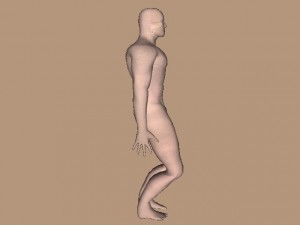
As the practitioner lowers their body, the hips should slowly rotate or pull forward. The motion is the same motion as thrusting the pelvis forward for the sexual motion. At some point the forward thrusting of the pelvis will feel like it should naturally stop. That is when the lowering of the hips should stop also. The rotation of the hips will naturally cause the lower back to move forward.
The upper torso should lean slightly backwards as a counterbalance to the foward moving hips.
Simultaneously, the hands are slowly raised up along the side of the body as the hands are made into a fist. The wrists will move to about armpit level. The shoulders might feel as if they are rotating forward. The picture below shows the final result of these actions.
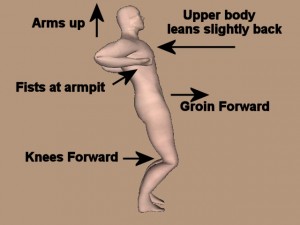
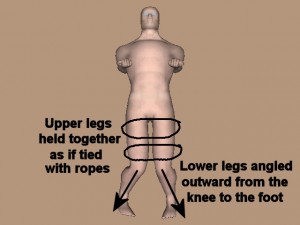
After the practitioner is in the position above, the legs still need to be adjusted. Right now, the legs of the person are still right next to each other. There are two common ways to position the feet for the Sil Lum Tau form.
Method #1 – This method uses 2 rotations of the feet to position the legs. The person will shift their weight onto their heels and rotate both toes outward to approximately 45 degrees. The weight is then shifted to the toes and the heels are rotated outward at an approximately 45 degree angle.
Method #2 – The second method uses 3 rotations to reach the same position. The weight is first shifted onto the toes while the heels are rotated outwards at 45 degrees. Then the weight is shifted to the heels while the toes are rotated outwards at 45 degrees. The weight is shifted back onto the toes again and the heels rotate approximately 45 degrees outward once again.
Whichever method is used, the feet should end up in approximately the same position. The knees and upper legs should still be held be close together. The lower leg angles from each knee outwards at approximately 45 degrees to each foot. In the profile view, the legs will look the same as they do in the picture above. The picture below shows how the lower legs spread outwards from the knees to the feet.
The purpose of this section is to show how triangles are involved in a real life martial art.
The arms initially hang straight down at the sides. There is no triangle formed by the shoulder/elbow/hand combination.
As the hands are pulled up towards the armpits, a triangle is formed by the shoulder/elbow/hand combination. The angle starts at 179 degrees when the arm is first bent. The next picture shows the arm bent to an arbitrary position. The angle from the shoulder to the hand is large.
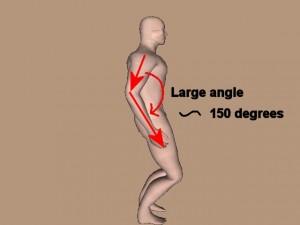
The next picture shows the arm bent a little bit more.
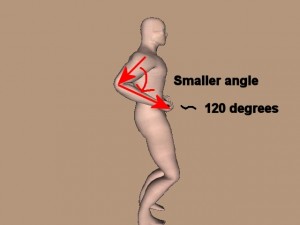
When the arm reaches it’s final position, there is approximately a 90 degree angle between the shoulder and hand.
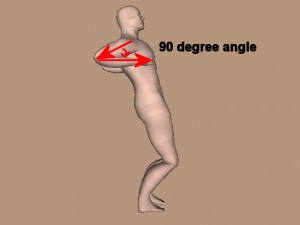
The physics forumlas that are demonstrated on the physics page all use triangles. All that is needed to convert the angles above to triangles is to close off the connection between the hand and the shoulder as shown below.
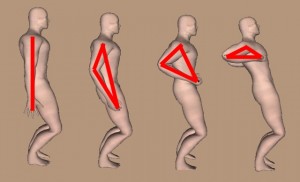
There is no triangle when the arm is hanging straight down. As the arm bends, you can see how the initial triangle is formed, then the changing of the interior angles of the triangle as the hand moves towards the armpit.
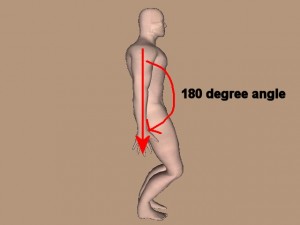
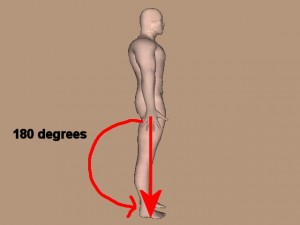
The same triangle changing process occurs when the practitioner initially lowers himself down into the stance. The picture below shows the model in a leg locked position. The angle is 180 degrees from the hip to the foot.
As the hips are lowered towards the feet, a triangle is formed by the hip/knee/foot combination. The angle starts at 179 degrees when the leg is first bent. The next picture shows the leg bent to an arbitrary position. The angle from the hip to the foot is large.
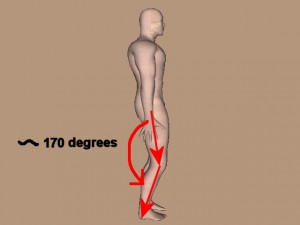
The next picture shows the legs bent a little bit more.
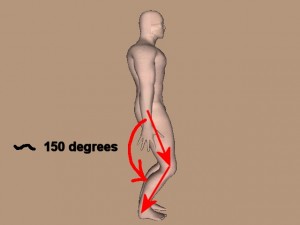
And the picture of when the person has finished lowering themselves into the stance.
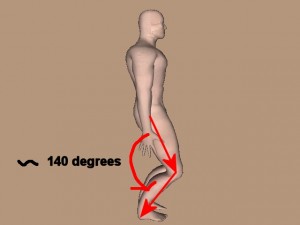
The physics forumlas that are demonstrated on the physics page all use triangles. All that is needed to convert the angles above to triangles is to close off the connection between the hip and the foot as shown below.
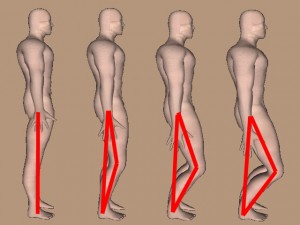
There is no triangle when the leg is locked straight. As the leg bends, you can see how the initial triangle is formed, then the changing of the interior angles of the triangle as the hip moves towards the foot.
A reasonable question at this point is “What use is this knowledge?”. It has already been stated that the laws of physics can be used to describe to the human body behaves while performing martial arts moves. How triangles, mathematics and physics formulas can be used to calculate the optimum position for an attack or a block to deliver or absorb the maximum amount of force.
The two movements demonstrated so far are for positioning the body in order to perform the Sil Lum Tau form. There is no blocking are defending being done. So who cares about the triangles that are formed during this opening movement?
You need to care. When the body is lowered into the stance and the arms are pulled upwards, there is an optimum position for the arms and the legs to be bent at. They can be bent at many angles that will all perform the necessary job of holding the person’s body up in the case of the legs, and holding the hands close to the body in the case of the arms.
There is one and only one maximum most efficient set of angles for the legs and the arms to take in order for the Sil Lum Tau form to train the body in the optimum way. You cannot really use this knowledge to help you choose the proper leg or arm position. Those proper angles will change as your body changes.
The knowledge can help ground you and maybe help you with the form. One facet of the process of grounding is to be mentally calm. The more calm you are, the more you can see and the better you can react. If you are uncertain about anything, that will make you less grounded. When you are nervous, you can also be said to have lost your ground.
Not understanding why you are doing the form in the way you are can cause mental stress or confusion. The instructor tells you to bend the legs and lift the arms, but when you ask him why, he says “because I told you so”. That is not a reason.
Some people might be bothered enough by not knowing the reason for doing a movement. Instead of performing the movement and concentrating on it or forgetting about it, they are mentally examining and worrying at the movement. They wonder why they are doing this movement instead of relaxing and performing the movement naturally.
For these kind of people, this knowledge of triangles and physics can be helpful. You now know that if you want to, you can learn some Geometry, Mathematics and Physics, then sit down with a pen and paper and figure out exactly why you put your legs where they are and your fists where they are. There is no doubt in numbers and mathematical formulas.
If someone asks you why you are doing what you are doing, you can authoritatively say that you are aligning your body in the most efficient way according to the laws of physics. Instead of the lame and sheepish sounding response of “Because my instructor told me that is the way to do it”.
Happeh Theory is focused on what is called “scholar warriors”. These men were educated and they knew martial arts. As opposed to being people who were only fighters that were good at martial arts. One of the basic laws of being a scholar warrior is being observant and curious. A scholar warrior looks at everything and wonders “why?”, because he knows there are no coincidences. Everything is for a reason if the scholar warrior observant enough to see it, curious enough to wonder about it, and intelligent enough to figure it out.
There is something in the previous series of pictures that most people would never see. They would have no reason to look in the first place. Yet this thing is a very powerful concept that requires a completely different understanding of the world than the one you probably have right now. I am referring to this picture.
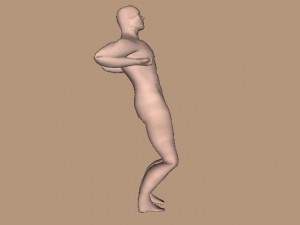
I will provide a demonstration of how scholar warriors work.
The above picture is the profile view of the Sil Lum Tau stance. Most people, when they see this picture, will say that is what they see. And then they stop thinking. They know the answer so they give up and walk away. It was just demonstrated that a person with a knowledge of Geometry sees triangles in the legs and the arms when they look at the picture. That first person who saw the Sil Lum Tau stance and walked away? He is not observant, he is not curious, he is arrogant because he thinks he knows everything, he is lazy because he gave up and walked away.
That means there are probably many other things in this picture that could be discussed. I am going to focus on one that I feel is special. Doesn’t the Sil Lum Tau stance look odd to you? The body is leaning way backwards like it is going to fall over. What possible use in the martial arts can there be to leaning backwards?
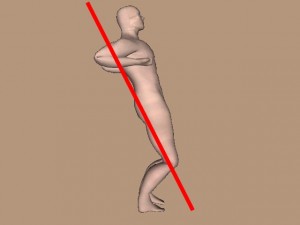
Since we are talking about the leaning of the back, let’s draw a line that highlights the lean of the back.
The man is standing on the ground. That is hard to tell with the picture all one color. Let’s draw in another line to highlight where the ground is.
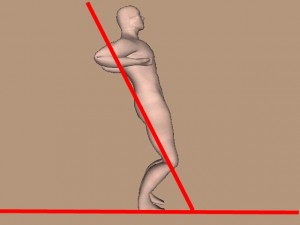
Now all anyone with any curiousity and intelligence needs to do is to think about the subject curently under discusion. Triangles. The angle of the model’s back and the ground form two lines of a triangle. All that needs to be done is to draw in the other line.
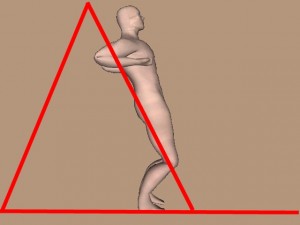
There is a triangle formed by the lean of the back in the Sil Lum Tau form and the ground. Just like the arms and the legs, there is some optimum angle at which the back should lean in order to transmit or absorb power with maximum efficiency. The angle will vary from person to person depending on their height and the condition of their body.
——————————
The next part of the discussion will begin with a clean version of the triangle that the Wing Chun practitioner appears to be leaning on.
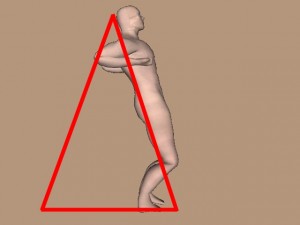
The triangle in the picture above is constructed of lines on the computer. To make it easier to think about, we will agree that the triangle above is made out of 1 inch thick pieces of something. If we were to look at the above picture from the rear, the triangle would be barely visible as a thin red line.
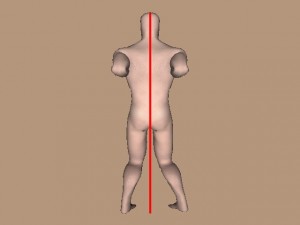
In the profile view, the triangle looks big and strong enough to easily support the leaning Wing Chun man’s body. From the rear view above though, the support looks weak. It looks like the man would wobble all over if he leaned his body weight back into that very thin red line. That makes it seem as if there is something wrong with this theoretical model we are building. If the theoretical model does not fit, then something needs to be changed.
This chapter is devoted to triangles on the human body. Examine the unaltered picture of the back of the model in the Sil Lum Tau stance again while keeping that in mind.
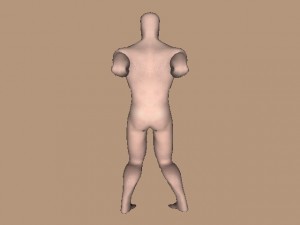
Since this entire section is about triangles, I am thinking about triangles. When I look at the back of this man there is a natural triangle formed by his legs.
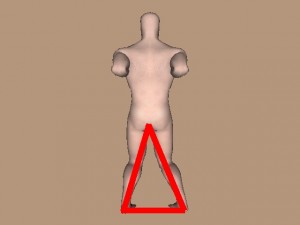
The triangle in the profile picture supported the entire body though. All that needs to be done to make the leg triangle support the body is to extend the peak of the triangle to the top of the head.
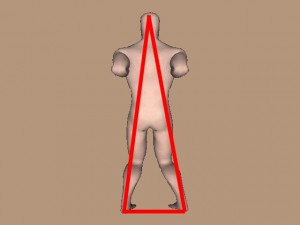
That triangle is very wide. It is as wide as the feet at ground level and remain wide up through the legs and lower torso. If the man was leaning back against that triangle, it seems like it could support him because of it’s orientation. The man’s body lays on the flat part of a triangle instead of on the edge like in the profile picture.
The comparison picture below is an attempt to highlight the similarities between an easel which holds up a painting and the theoretical triangles holding up the human body in the Sil Lum Tau stance. The human model was rotated so that it is in the same orientation as the easel. Even though we are looking at the front of the human being, the triangle is just the same as it is in the rear view. It runs from the head to each foot.
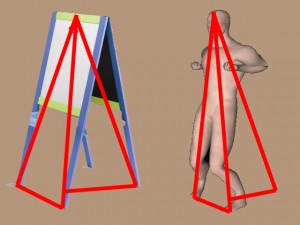
Instead of the rectangular surface used to hold a painting, a triangle is drawn on the front of the easel that to match the triangle on the front or rear view of the human body. The triangular shape of the easel in the profile view is easy to see. The red triangle was drawn in anyways to highlight the correspondence the the triangle on the human being profile picture.
If you look at the picture above, it seems kind of wrong. The lines on the profile triangle intersect the front triangle a little bit up the leg of the triangle instead of on the ground. That is how the triangular brace for the easel would look because it is connected to the center of the easel.
To make the picture look better, the bottom line of the triangular brace for the easel could be drawn to the edge of the easel as shown below.
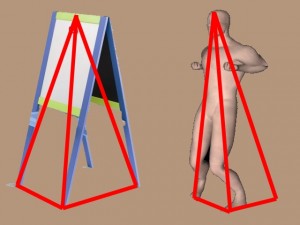
Doesn’t that picture look “right” now? Instead of the ugly line partway up the leg of the front triangle, the lines are connected all nice and neat at the corners.
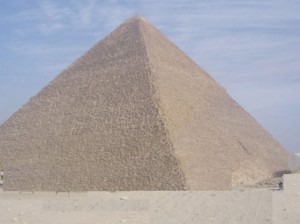
What does that shape above look like to you? It should look like a Pyramid.
The picture below compares the easel, the man, and a pyramid.
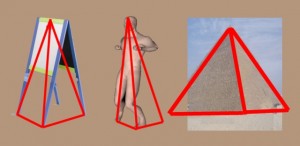
To be thorough there is something that needs to be noted. In the easel and the man picture, we were drawing 2 dimensional triangles. In the picture of the easel and the man above, the red triangle lines form only one half of a Pyramid. The rear and opposite side triangles need to be added to complete the 3 dimensional, space enclosing shape of a pyramid.
The rear and opposite side triangles can be added without changing the theoretical model up to this point.
The purpose of all of the previous discussion was to get to the point in the picture below. The similarity if the man, the easel and the Pyramid.
Because of the theoretical model and the similarities of the picture above, Instead of saying that a person in the Sil Lum Tau stance is leaning back on a triangle, we can say that he is leaning back on a Pyramid. The picture below demonstrates why it was necessary to start with triangles and work up to the Pyramid.
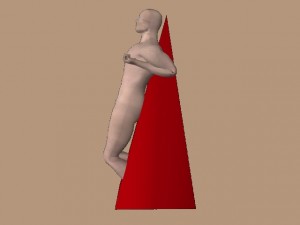
The picture above is a three dimensional computer rendering of the man leaning against a Pyramid. In the profile view all that is visible is the side triangle of the Pyramid. There is no way to verify that the red triangle is really a three dimensional Pyramid. The picture below shows the Pyramid the man is leaning on from behind and above.
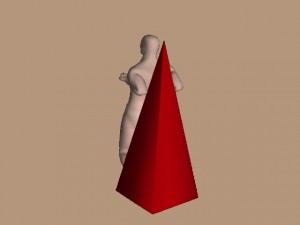
That picture is still not complete proof. Now two sides of the Pyramid are visible. They could be just two triangles instead of space enclosing Pyramid. The only way to verify that the man is indeed leaning on a Pyramid is from an overhead or bottom view.
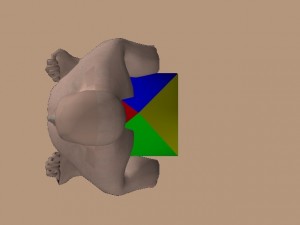
The Pyramid sides have different colors to enhance the visibility. In the overhead view we can verify that there is indeed a four sided Pyramid that the man is leaning on.
Now that it has been shown that the man can be described as leaning back on a Pyramid, so what? What was the point of all of that discussion?
Happeh Theory says that in real life, human beings have a Pyramid inside of them. There is collection of muscles, tendons etc that work together to form a Pyramid shape inside of a person’s body. The Pyramid inside of the body looks something like this.
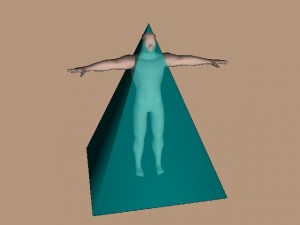
The next picture is a comparison picture between the Pyramid inside of a person and the Pyramid that the person the Sil Lum Tau stance can be said to be leaning on.
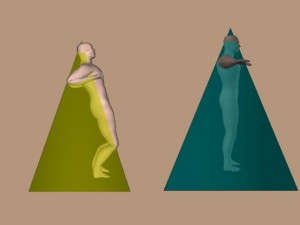
What are the differences in the above two pictures? The Pyramid has moved from the center of the man to behind the man. The man’s body has moved from a standing up straight posture to a leaning backwards posture. The Pyramid can be said to rotate or slide backwards from it’s normal position as a result of the movements that are performed to put a person in the Sil Lum Tau stance.
You should note the exact positioning of the Pyramid behind the man. The peak of the Pyramid is still at the center of the head. The rear part of the head is enclosed in the Pyramid, as is the rear part of the torso and the legs. Here is a large version of the Pyramid behind the person by itself.
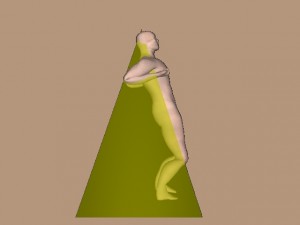
We are still not finished thinking through the ramifications of all of this. Everything, no matter how trivial, needs to be considered for any connection to any idea you have ever encountered in your life. A scholar warrior is mentally alert for connections of intellectual ideas etc as well as being physically alert for possible danger.
The man is leaning on the Pyramid in the picture above. What happens when one object leans on the other object? The weight of the object on top is resting on or added to the weight of the object on the bottom. That means the weight of the man is resting on the Pyramid.
What happens to a weight that is resting on a living object? The same thing happens. The weight of the object on top rest on or is added to the living thing. How does the living thing react? Because it is alive, the living thing will grow in order to support the added weight of the object that is laying on it. This is the principle of weight lifting. Laying heavy bars of iron on the muscles so that the muscles grow to support the added weight.
The Pyramid in the human body is formed of the living human body. The Pyramid can be described as being alive. That would mean that the human body laying on the Pyramid behind it would cause the Pyramid to grow stronger to support the added weight. The process of leaning back into the Sil Lum Tau stance would strengthen the Pyramid inside of the body in the same way that doing pushups or situps would strengthen the arms or the stomach.
It does not matter that there is not a large Pyramid surrounding the human body that is visible to the naked eye. It does not matter that we cannot see this large Pyramid move when the person gets into the Sil Lum Tau stance. What matters is that the body behaves or reacts as if this is what is happening. The physical structure of the body will change as if the Pyramid is a real solid physical thing that is being moved and exercised